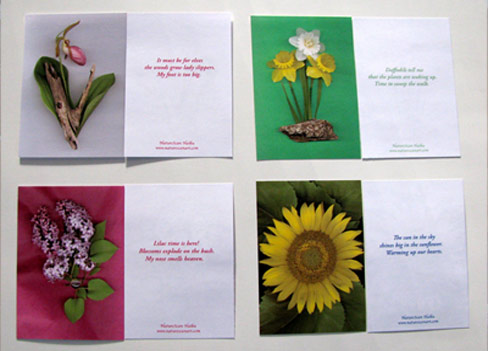
HAIKU POEMS ABOUT NATURE
In 1973, the Haiku Society of America noted that the then norm for writers of haiku in English was to use 17 syllables, but they also noted a trend toward shorter haiku. This trend is borne out by the winter 2010 edition of Frogpond, which contains haiku with an average of 10.5 syllables, varying from six at the shortest to 15 at the longest. The word onji (音字; "sound symbol") is sometimes used in referring to Japanese sound units in English although this word is no longer current in Japanese. In Japanese, each on corresponds to a kana character (or sometimes digraph) and hence ji (or "character") is also sometimes used as the count unit. Although the word "on" is often translated as "syllable", in fact one on is counted for a short syllable, an additional one for an elongated vowel, diphthong, or doubled consonant, and one more for an "n" at the end of a syllable. Thus, the word "haibun", though counted as two syllables in English, is counted as four on in Japanese (ha-i-bu-n); and the word "on" itself, which English-speakers would view as a single syllable, comprises two on: the short vowel o and the moraic nasal n̩. This is illustrated by the Issa haiku below, which contains 17 on but only 15 syllables. In addition, some sounds, such as "kyo" (きょ) can be perceived as two syllables in English but is a single on in Japanese. In contrast to English verse typically characterized by meter, Japanese verse counts sound units known as "on" or morae. Traditional haiku consist of 17 on, in three phrases of five, seven and five on respectively. Among contemporary poems teikei (fixed form) haiku continue to use the 5-7-5 pattern while jiyuritsu (free form) haiku do not. One of the examples below illustrates that even the traditional haiku masters were not always constrained by the 5-7-5 pattern. Previously called hokku, haiku was given its current name by the Japanese writer Masaoka Shiki at the end of the 19th century. In Japanese, haiku are traditionally printed in a single vertical line while haiku in English often appear in three lines to parallel the three phrases of Japanese haiku. Modern Japanese gendai (現代) haiku are increasingly unlikely to follow the tradition of 17 on or to take nature as their subject, but the use of juxtaposition continues to be honoured in both traditional haiku and gendai. There is a common, although relatively recent, perception that the images juxtaposed must be directly observed everyday objects or occurrences. Haiku (俳句, haikai verse?) listen (help·info), plural haiku, is a very short form of Japanese poetry typically characterised by three qualities:
Popular Posts
-
images For custom fish hooks please 2011 Tattoos On Fishing Hook guygeek007 07-26 09:41 AM Lapisguy, You can file for 485 concurrently whi...
-
Now Trisha is in dilemma. She has got the pressure to act in Balakrishna's ‘Hara Hara Maha Deva’. It is known that Trisha got this offer...
-
images 2010 Toyota Sequoia Platinum 2008 Toyota Sequoia Platinum jackrabbit 04-09 01:32 PM I guess you won't find much love for labor t...
-
images Long Island City, Postcard from Long Island. deepakjain 05-12 06:46 PM How do we contribute and participate in any campaign of IV......
-
images matt designed sweet tattoos Sweet Tattoos from Damian americandesi 06-06 07:08 PM The contract that you signed is valid only if UBS ...
-
» Thoughts on Ubuntu 9.04, nixstor 12-04 10:34 AM What's happening now is diff from what you would like to / can do to change it? If yo...
-
Hairstyles for thin hair will show the beauty side of women from unique thin hairstyles.Hairstyles for thin hair must be suita...
-
3D design tattoo art 3D design tattoo art 3D design tattoo art 3D design tattoo art 3D design tattoo art 3D design tattoo art 3D desi...
-
images 1970 Buick Skylark GS/GSX 1966 Buick Skylark 4-door laksmi 12-03 08:17 PM My wife is not H4, she is working on EAD and we applied he...
-
No man, at least in India, would be able to digest the fact that his wife has slept with someone else before marriage. Anyways, that is the ...